
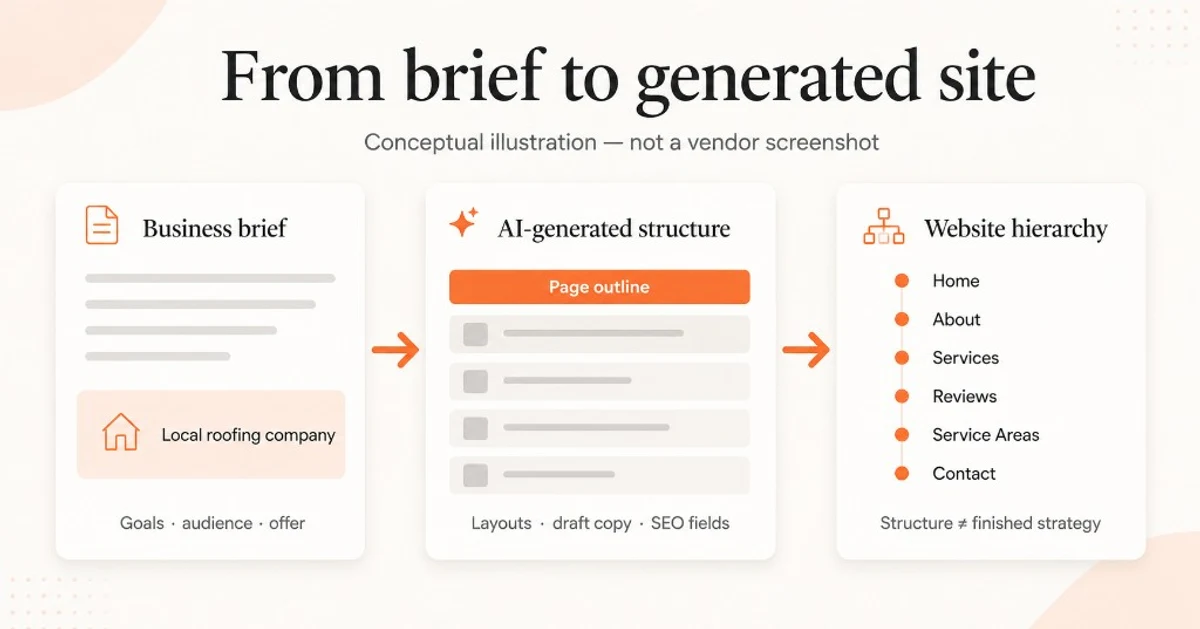
An AI-powered website builder uses artificial intelligence to generate or assist with site structure, layouts, page copy, images, navigation, forms, SEO metadata, and sometimes ecommerce or booking features. In practical terms, you describe your business—or answer a short questionnaire—and the platform drafts a starting website you can edit and publish.
That definition sounds simple. Implementation is not. Some tools add AI on top of a mature visual editor. Others generate a full site in under a minute. Design-oriented platforms prioritize craft after generation. Prompt-to-app systems may produce code closer to a custom application than a classic marketing site. Generating a website quickly is not the same as building a website that performs for a real business.
Smartlance builds websites and modern business systems—website design, development, SEO, conversion, and AI & automation. This guide is how we help business owners decide when an AI website builder is enough, and when professional work is the better investment.
Quick answer
An AI website builder can accelerate:
- First drafts of pages and section layouts
- Initial navigation and site structure
- Draft headlines, body copy, and calls to action
- Placeholder or generated visuals
- Basic responsive layouts
- Starter SEO fields (titles, descriptions, headings)
- Guided editing after the first generation
What it does not automatically guarantee:
- Distinct brand positioning
- Strong conversion architecture
- Competitive SEO outcomes
- Correct local SEO structure
- Accurate business claims
- Excellent performance and accessibility
- Durable CRM, booking, or automation integrations
- Long-term maintainability without human oversight
What AI website builders can actually do
Based on how current platforms position their AI features, most AI website builders (and AI-assisted editors) are strong at getting you to a usable draft:
Structure and layout. Many tools propose pages (Home, About, Services, Contact) and section patterns (hero, features, testimonials, FAQ, footer). That scaffolding is often “good enough” for a simple brochure site.
Copy drafting. AI can write service descriptions, about-page narratives, and meta descriptions. The useful part is speed. The risk is generic claims that do not match how you actually sell.
Visual suggestions. Platforms may generate images, suggest stock, or apply design themes. Speed is high. Image weight and brand fit still need review.
Editing assistance. Conversational editors (for example, AI agents inside established builders) can rearrange sections, rewrite text, or add pages after the first draft.
Starter SEO fields. Titles, meta descriptions, and heading suggestions are common. Control depth varies widely by platform—and control matters more than autofill.
Basic ecommerce or business widgets. Some AI-first tools and mature platforms can attach bookings, forms, or storefront modules during or after generation. Depth and flexibility still differ by product.
What AI website builders still struggle with
This is the part most marketing pages underplay.
Differentiation. If ten competitors in your city generate sites from similar prompts, the output often shares the same layout rhythm, section order, and “we’re passionate about excellence” tone. Looking modern is not the same as looking like you.
Conversion architecture. A site can look polished and still fail to explain what you do, why it matters, and what to do next. Clear offers, trust cues, and one primary action still need human judgment. See what makes a website convert.
Accurate business claims. AI invents confident copy. Licensing details, service areas, pricing ranges, and guarantees must be verified by the business—not left to a model.
Local SEO complexity. An AI builder can create a Contact page. Local visibility often still needs service/location architecture, Google Business Profile alignment, location-specific content, reviews strategy, and structured internal linking. Explore local SEO and local business visibility.
Technical performance. AI-generated visuals can be heavier than necessary. Performance still requires responsive images, modern formats, lazy loading, LCP discipline, and sensible caching. See technical SEO foundations.
Accessibility. Generated pages can still need human review for contrast, alt text, heading order, keyboard navigation, and form labels.
Integrations and ownership. Connecting CRM, payments, analytics, automation, and APIs—and retaining the ability to export or migrate—varies by platform. Assume nothing until you verify the specific product.
Maintenance after day one. Generation is a moment. Businesses still need content updates, security, SEO iteration, analytics review, and conversion improvements.
How we evaluate an AI website builder
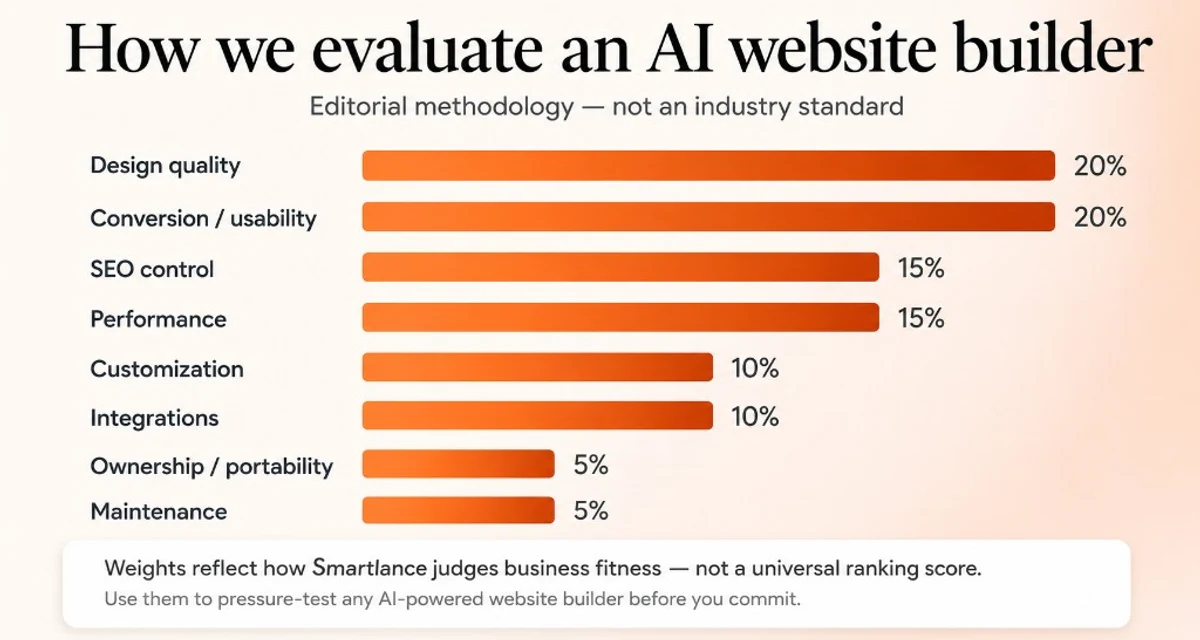
Smartlance uses an editorial evaluation framework when advising clients. These weights are our methodology, not an objective industry standard. They exist to force practical questions before you commit.
| Category | Weight | What we mean |
|---|---|---|
| Design quality | 20% | Does the output look intentionally designed rather than generic? |
| Conversion / business usability | 20% | Can a visitor understand what you do, why it matters, and what to do next? |
| SEO control | 15% | Can you control titles, meta, headings, URLs, indexability, content structure, and structured data where relevant? |
| Performance | 15% | Can the site deliver quickly and efficiently on real devices? |
| Customization | 10% | Can you go beyond the generated template without fighting the tool? |
| Integrations | 10% | Can it connect to CRM, forms, booking, payments, analytics, automation, and APIs? |
| Ownership / portability | 5% | Can you export, move, or retain meaningful control if you leave the platform? |
| Maintenance | 5% | What happens after the initial generation—updates, support, and ongoing edits? |
The major types of AI website builders
“AI website builder” is not one product category. Treating every tool as interchangeable leads to bad buying decisions.
AI-assisted traditional builders
Examples (based on current product positioning): Wix, Squarespace, and Elementor (WordPress).
These platforms already had mature editors, templates, hosting or CMS ecosystems, and business apps. AI accelerates onboarding and editing—Wix’s Harmony/Aria workflow, Squarespace Blueprint AI / Design Intelligence, Elementor’s AI planning and assistive tools—without replacing the underlying product model.
Best fit: businesses that want a known ecosystem plus faster first drafts.
Watch for: AI as an acceleration layer, not a guarantee of unique brand or advanced custom logic.
AI-first website generators
Examples (based on current product positioning): Hostinger, Durable, 10Web.
These tools emphasize speed-to-live: describe the business, get a draft site quickly, then edit. Hostinger pairs generation with hosting bundles; Durable emphasizes ultra-fast small-business launches; 10Web generates toward a WordPress site (a different portability story than pure SaaS builders).
Best fit: simple local or service businesses that need a professional-looking first version fast.
Watch for: design ceilings, export/lock-in differences, and how deep SEO and integrations go after launch.
Design-oriented AI builders
Examples (based on current product positioning): Framer and Webflow where AI drafts an editable foundation on a design-forward canvas.
These tools are often stronger when visual craft and structured editing matter after generation. The output stays in a visual system rather than a one-shot “publish and hope” flow.
Best fit: marketing sites, portfolios, and brands that care about design control after the draft.
Watch for: steeper learning curves than “30-second” SMB generators; CMS and SEO depth still vary by platform and plan.
AI coding / prompt-to-app platforms
Examples (based on current product positioning): Lovable, Bolt, Replit, and v0.
These systems generate working UI and often application code—sometimes with auth, databases, or deploy hooks. They appear in “AI website builder” roundups, but the product intent is closer to apps and prototypes than a classic brochure website with marketing CMS and SEO operations.
Best fit: founders building product MVPs, internal tools, or custom interfaces—especially with technical support available.
Watch for: mistaking a generated app shell for a durable marketing website with content operations, local SEO, and conversion systems.
What AI-built websites need beyond generation
After the generator finishes, a business website still needs:
- Clear offer and proof — services, differentiators, credentials, reviews
- Conversion path — one primary next step per important page
- SEO architecture — crawlable structure, intentional URLs, internal links
- Local relevance (when applicable) — service areas, NAP consistency, GBP alignment
- Performance and accessibility pass
- Measurement — analytics that answer “what happens after the click?”
- Integrations — forms to CRM, booking, payments, follow-up
- Ownership plan — hosting dependency, export, and who maintains what
A site can look excellent and still fail to generate enquiries, capture leads, rank locally, connect to a CRM, follow up with customers, or explain the next step. That gap is where website strategy, SEO, conversion work, and AI & automation meet.
What AI website builders don't tell you
Generic positioning
AI drafts what sounds plausible for your industry. Plausible is not distinctive. If your homepage could belong to any competitor after swapping the logo, the positioning is too weak.
Weak conversion architecture
Pretty sections without a clear offer create traffic without pipelines. Forms that ask too much, vague CTAs, and buried contact paths are common failure modes—even on “AI-optimized” templates.
Generic SEO
Autofilled titles and meta descriptions are a starting point. They are not a content strategy, a topical map, or a technical SEO foundation.
Local SEO is more than a Contact page
AI may generate a service area list. Ranking and converting local demand often needs location-aware pages, internal linking, and real-world signals that sit outside the builder’s generation step.
Technical performance and image weight
Generated hero images and decorative graphics can quietly hurt LCP. Performance is still engineering: formats, sizes, lazy loading, and lean front-end delivery.
Integrations, CRM, and analytics
Many builders include form widgets. Fewer make it easy to push qualified leads into your CRM with assignment rules, SLAs, and follow-up. If lead response time matters, plan the workflow—not just the form. See respond to leads faster and CRM / lead automation.
Maintenance and ownership
Ask before you buy:
- Can I export content or code?
- Am I locked to this host forever?
- How hard is migration?
- Who updates plugins, themes, or platform dependencies?
- What breaks when I need a custom workflow?
Do not assume every vendor answers these the same way. Features change quickly—verify on the current product, not a 2024 blog post.
AI website builder vs professional web design
You do not always need an agency. If an AI builder solves your actual problem well, it may be the right choice. Use this comparison as a decision aid—not absolute law.
| Need | AI builder | Professional build |
|---|---|---|
| Simple brochure site | Strong | Optional |
| Personal portfolio | Strong | Optional |
| Quick MVP | Strong | Optional |
| Temporary campaign page | Strong | Optional |
| Basic local business site | Good | Often worthwhile |
| Competitive SEO | Depends | Stronger control |
| Custom integrations | Limited / varies | Strong |
| Complex ecommerce | Depends | Strong |
| Conversion-focused site | Depends | Strong |
| Custom workflows | Limited | Strong |
| CRM / automation | Varies | Strong |
| Long-term growth systems | Depends | Strong |
Professional work is not “AI vs humans.” It is strategy, design judgment, technical control, and systems that keep working after launch—often including AI tools in the process.
Which option is right for your business?
When an AI builder makes sense
- Simple brochure site
- Personal site or portfolio
- Early MVP to validate messaging
- Temporary campaign or event microsite
- Simple local business with low competitive pressure
- Budget-constrained first version you will improve later
When a professional build makes sense
- Competitive SEO markets
- Complex conversion goals (multi-step funnels, high-ticket services)
- Multiple integrations (CRM, booking, payments, automation)
- Custom business workflows
- Ecommerce complexity beyond a basic catalog
- Strong brand differentiation requirements
- Custom functionality or applications
- Lead systems that need AI agents, workflow automation, or deep integrations
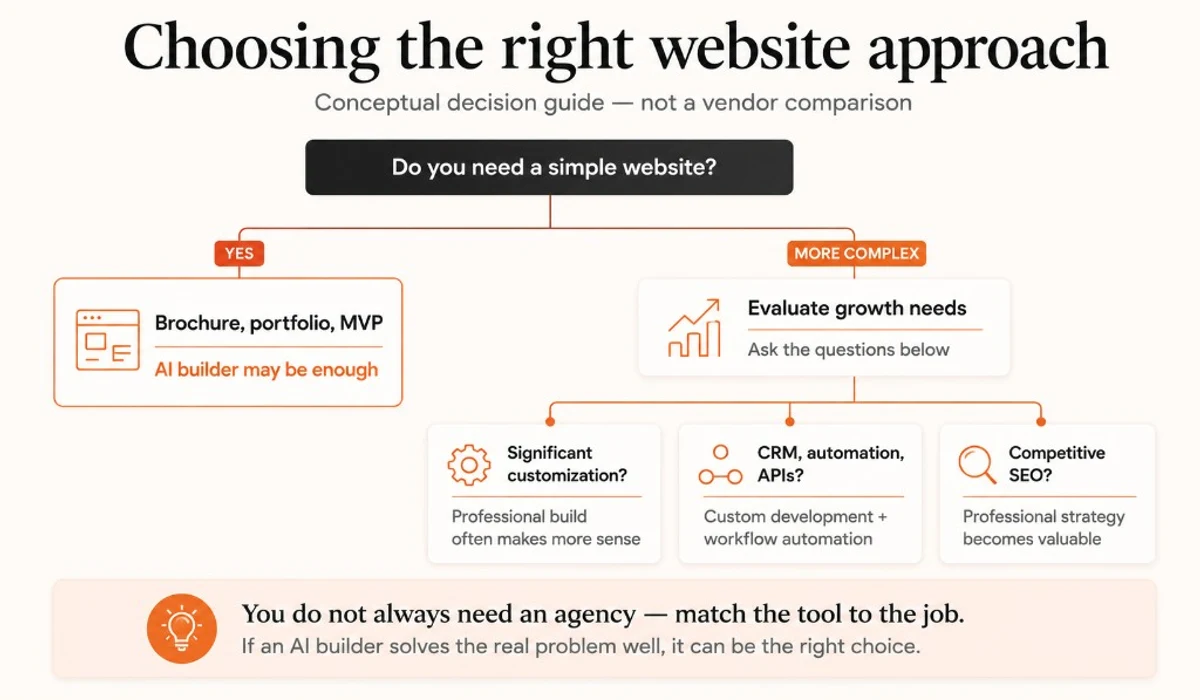
Text decision tree
- Do you need a simple website? → An AI builder may be enough.
- Need significant customization? → A professional build may make more sense.
- Need CRM, automation, or custom APIs? → Consider custom development plus automation.
- Need competitive SEO and growth? → Professional strategy becomes more valuable.
If you are planning a new site, start with a structured brief: Build Your Website Brief. If you already have a site and wonder whether AI DIY or a redesign is smarter, get a free website review.
Illustrative test briefs
These are illustrative test briefs—example scenarios for how we would pressure-test any AI-powered website builder. They are not claims that Smartlance ran these exact prompts on every platform.
Illustrative test brief 1 — Local business (Austin roofing)
Business: Residential roofing company serving Austin and nearby suburbs.
Goal: Calls and form leads for inspections and replacements.
Must evaluate: Service pages, service-area structure, trust (reviews, licenses, insurance), mobile call CTA, speed of lead notification.
AI builder success looks like: Clear services, local relevance, obvious phone/form path.
Professional help becomes likely when: Multiple cities/services need SEO architecture, review systems, and CRM follow-up.
Illustrative test brief 2 — Professional service (New York accounting firm)
Business: CPA firm serving small businesses and individuals in New York.
Goal: Qualified consultation requests—not tire-kickers.
Must evaluate: Credibility (team, credentials), service clarity (tax, bookkeeping, advisory), form qualification, appointment booking, content depth for SEO.
AI builder success looks like: Trustworthy presentation and a clean enquiry path.
Professional help becomes likely when: Content strategy, competitive SEO, and client intake workflows matter more than launch speed.
Illustrative test brief 3 — Ecommerce (California skincare brand)
Business: DTC skincare brand shipping nationwide from California.
Goal: Product discovery, education, and purchase—with email capture.
Must evaluate: Product templates, collections, PDP clarity, checkout friction, image performance, policy pages, analytics.
AI builder success looks like: Credible storefront for a focused catalog.
Professional help becomes likely when: Merchandising rules, custom checkout, subscriptions, or complex ecommerce development enter the picture.
If you actually test a platform yourself, document: prompt used, raw output, editing effort, SEO controls, mobile behavior, performance, and integrations. If you did not test it, do not claim you did.
Where Smartlance fits
You don’t always need an agency to build a website.
If an AI website builder gets you a clear, fast, maintainable site that matches your goals—use it. That can be the smartest business decision for a first version.
If the project requires custom design, SEO architecture, conversion strategy, CRM integration, lead automation, AI agents, business workflows, ecommerce complexity, or custom functionality, Smartlance can help. We sit at the intersection of web + growth + AI + automation—not as an anti-AI stance, and not as AI hype.
Explore:
- Website design and website development
- SEO and conversion rate optimization
- AI & automation, including AI agents and workflow automation
- Solutions like new business website, low website conversions, and automate repetitive work
- Real projects on Work
How modern websites connect to AI and automation
A website is often the front door—not the whole system. Examples (not prescriptions):
Lead path
Website → Lead → Qualification → CRM → Assignment → Follow-up
Enquiry assistance
Website → Customer enquiry → AI assistance → Human handoff
Booking path
Website → Booking → Payment → CRM
Those flows are why “AI website builder” and “AI for business operations” are related but not identical. Generation creates pages. Operations create outcomes. See AI & automation and CRM lead automation when the bottleneck is what happens after the form submit.
Frequently asked questions
Can AI build an entire website?
AI can generate a complete first draft—pages, layouts, copy, and often images—on many platforms. “Entire” in the sense of a finished business asset still depends on human review for accuracy, brand, conversion, SEO, accessibility, and integrations.
Are AI website builders good for small businesses?
Often yes for simple sites and early versions—especially when budget and speed matter. They are less reliable as a complete strategy in competitive markets or when custom workflows are required.
Is an AI-generated website good for SEO?
It can be a starting point if the platform gives you control over titles, headings, URLs, indexability, and content structure. Generation alone does not produce competitive rankings. Technical and local SEO still matter.
Can AI build an ecommerce website?
Many tools can generate a storefront draft. Complex catalogs, custom checkout, subscriptions, and merchandising usually need more than a first generation—sometimes a dedicated ecommerce build.
Can I build a website with AI without coding?
Yes. Most AI-assisted and AI-first website builders are designed for non-developers. Prompt-to-app tools may still benefit from technical review if you need production-grade applications.
What is the best AI-powered website builder?
There is no single best tool. The right choice depends on site type (brochure vs ecommerce vs app), design control, SEO needs, integrations, ownership, and maintenance. Use the evaluation framework above instead of chasing roundup rankings.
Is it better to use AI or hire a web designer?
Use AI when the job is a simple, fast first version. Hire professional help when brand differentiation, competitive SEO, conversion systems, or custom integrations determine business outcomes. Many strong projects use both.
How much does an AI website builder cost?
Pricing changes frequently by plan and vendor. Compare current official pricing, what is included (hosting, domain, commerce, AI credits), and migration costs—not just the intro rate.
Can I own an AI-generated website?
You typically own your content, but portability of design/code varies. Some platforms are hosted SaaS with limited export; others (for example, WordPress-oriented generators) offer a clearer path to move. Verify export and hosting dependency before you invest heavily.
Can AI maintain my website?
AI can assist with updates and content drafts. Businesses still need humans for accuracy, security decisions, SEO iteration, conversion improvements, and integration maintenance.
Final recommendation
AI website builders are excellent for getting from idea to first version quickly. They are not automatically a complete business website strategy.
The right choice depends on complexity, growth goals, SEO, customization, integrations, and maintenance. Match the tool to the job. Be honest about what “done” means for your business—not what a demo video implies.
Ready to build a website?
Have an existing website?
Planning from scratch? Build Your Website Brief.
Related reading: website redesign checklist, what makes a website convert, and technical SEO foundations.